-
tel: +86-133 3812 3788
-
email: erwpipemill@gmail.com

EN
How to Choose a Tube Mill Model by Tube Size and Wall Thickness
May 12, 2026
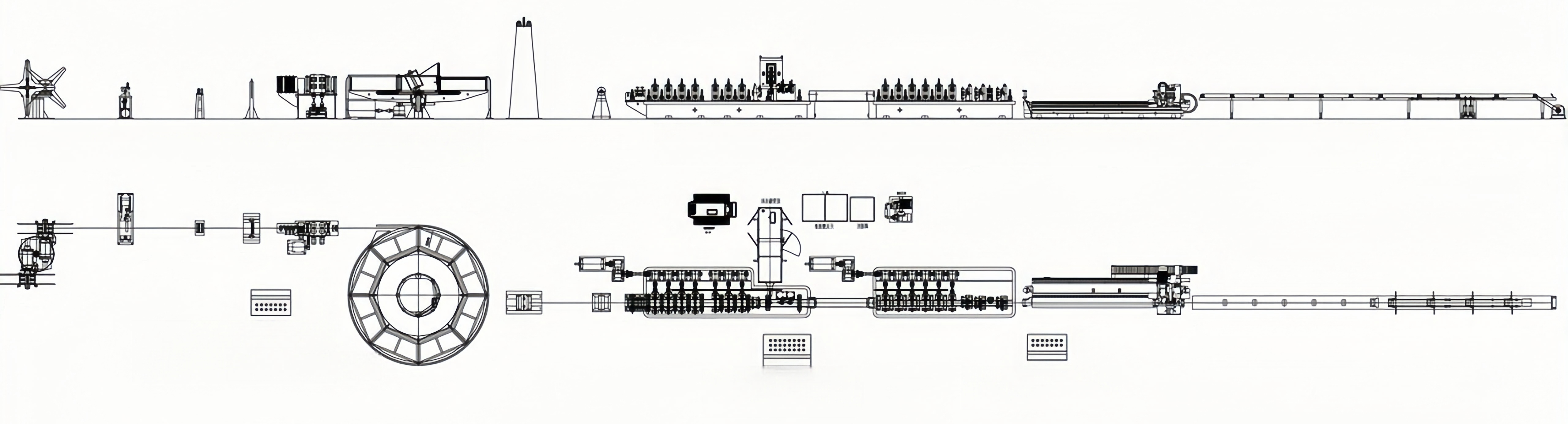
Choosing the right tube mill model is one of the most important decisions in a tube production project. Many buyers first ask for a machine based only on a general range, such as 20-80 mm or 0.8-3.0 mm. That is useful for an initial discussion, but it is not enough for accurate model selection, quotation, or production planning.
XFX Tube Mill Machinery Co., Ltd. recommends selecting a tube mill model according to the exact tube size and the matching wall thickness for each main product. This helps reduce the risk of buying an unsuitable line, underestimating the required configuration, or comparing quotations incorrectly.
Why General Size Range Is Not Enough
A general production range does not explain what the customer will really produce. A line that can cover a broad round tube range may still need careful checking when the buyer wants heavier wall thickness, square tube production, rectangular tube production, or stricter cutting quality.
For example, these requests are much more useful than only giving a broad range:
- Round tube: Φ25 mm x 1.2 mm
- Square tube: 40 x 40 mm x 1.5 mm
- Rectangular tube: 40 x 60 mm x 2.0 mm
These exact specifications allow the factory to check forming load, welding requirement, sizing strength, roll tooling scope, cutting requirement, and suitable model range.
Tube Size and Wall Thickness Must Be Checked Together
Tube size and wall thickness should never be separated during model selection. A 50 mm tube with light wall thickness and a 50 mm tube with heavier wall thickness may need different configuration strength, welding capacity, and cutting arrangement.
When buyers only send one overall thickness range, the supplier still needs to ask which wall thickness matches which tube size. Without this information, any model suggestion is only preliminary.
Start with Your Main Production Tubes
Many buyers plan to produce more than one tube size, but usually there are a few main products that drive the project. These main products should be listed clearly before the tube mill model is confirmed.
A practical list may include:
- Main round tube sizes and wall thickness
- Main square tube sizes and wall thickness
- Main rectangular tube sizes and wall thickness
- Occasional sizes that are less important
This helps the manufacturer balance production range, tooling plan, HF welder selection, and overall budget.
Reference Model Ranges for Initial Discussion
The following ranges are only for reference during the first discussion. Final selection must depend on actual tube size, wall thickness, material, and configuration.
| Model | Round Tube Reference Range | Thickness Reference Range | Typical Discussion Direction |
|---|---|---|---|
| FX28 | Φ10-38 mm | 0.4-1.8 mm | Small diameter light-wall tube projects |
| FX45 | Φ16-63 mm | 0.6-2.5 mm | Common small to medium production |
| FX50 | Φ19-76 mm | 0.7-3.0 mm | Medium production with wider application |
| FX60 | Φ25-89 mm | 0.8-3.5 mm | Medium production with heavier wall options |
These ranges should not be treated as a promise that one model can cover every shape and every wall thickness inside the broad range. The exact production list still needs to be reviewed carefully.
For reference, you can also review our common machine groups for small tube mills, medium tube making machines, and larger medium tube projects.
Tube Shape Also Affects Model Selection
If the project includes square tube and rectangular tube production, the selection becomes more specific. A machine that can produce a certain round tube size does not automatically suit all square and rectangular tube sizes within a similar range.
That is why buyers should clearly state whether the project will produce:
- Round tube only
- Round and square tube
- Round, square, and rectangular tube
The answer affects forming design, sizing section, tooling scope, and final quotation structure.
Wall Thickness Changes More Than the Machine Model
Heavier wall thickness may affect more than one machine section. It can influence:
- Forming strength
- HF welder matching
- Sizing stability
- Cutting system load
- Required tooling design
- Production speed expectation
Because of this, buyers should not compare machine prices only by outer diameter range. Two quotations with similar nominal tube range may actually describe different capacity levels.
Cutting Quality Requirement Should Be Confirmed Early
The cutting section should also match the production plan. If the buyer needs cleaner tube ends, better cutting face quality, or smoother downstream fabrication, a cold saw cutting machine may be more suitable. For some standard production plans, a hot friction saw may still be practical.
This decision depends on tube size, wall thickness, speed, finished tube use, and budget.
What the Factory Should Check Before Recommending a Model
A responsible tube mill manufacturer should review more than one number. Before recommending a model, the factory should check:
- Tube shape: round, square, rectangular, or mixed production
- Exact tube size and wall thickness for each main product
- Raw material and steel grade if available
- Required cutting quality and line speed expectation
- Need for auxiliary equipment such as slitting line, zinc spraying, or automatic packing
- Country, voltage, purchase time, and service expectation
Common Buyer Mistakes When Selecting a Tube Mill Model
- Sending only a broad size range without exact production sizes
- Ignoring the matching wall thickness for each size
- Assuming a round tube range automatically covers all square tube production
- Comparing quotations only by price
- Not checking service scope, installation, training, and spare parts support
How XFX Helps You Select a Suitable Tube Mill Model
XFX Tube Mill Machinery Co., Ltd. is a real factory in Yangzhou, China. We design and manufacture high frequency welded tube mills, ERW tube mills, slitting lines, HF welders, cold saw cutting machines, and related equipment for overseas B2B buyers.
We recommend the model according to your actual production plan instead of guessing only from a broad range. This helps you reduce model selection risk and receive a more useful quotation.
FAQ
Can I choose a tube mill model only by tube diameter range?
No. Tube diameter range alone is not enough. The model should be checked with exact tube size, matching wall thickness, tube shape, raw material, and required configuration.
Why does wall thickness matter so much?
Wall thickness affects forming load, HF welder matching, sizing stability, cutting requirement, tooling design, and sometimes speed expectation. That is why it must be matched with each target tube size.
Can one model produce round, square, and rectangular tubes?
In many projects, one line can be configured for mixed production, but the final scope depends on actual tube sizes, wall thickness, tooling plan, and machine configuration. Final confirmation should come after reviewing the real production list.
What information should I send before asking for a quotation?
Please send tube shape, exact tube size, matching wall thickness, raw material, country, purchase time, company name, and your WhatsApp or email. If possible, also send the main products and less common sizes separately.
Send Your Tube Specifications for Model Recommendation
If you are planning a new tube production line or expanding your existing plant, send your tube specifications to XFX:
- Tube shape: round / square / rectangular
- Exact tube size
- Matching wall thickness
- Raw material
- Country
- Purchase time
- WhatsApp or email
- Company name
We will help you review a suitable tube mill model and configuration based on your real production needs.
Recent Posts

October 26, 2016
The Most Successful Engineering ContractorJun 09, 2026
How to Reduce Scrap Rate in ERW Tube Mill ProductionRequest a Tube Mill Quote
Tube Mill Inquiry Information
Line Quantity
Unit
Set
Please send your tube shape, exact tube size, wall thickness, raw material, country, purchase time, WhatsApp or email, and company name. XFX will help check the suitable tube mill model and configuration for your production plan.