-
tel: +86-133 3812 3788
-
email: erwpipemill@gmail.com

EN
Can One Tube Mill Cover Your Full Size Range? What Buyers Should Check
May 12, 2026
Many buyers hope one tube mill can cover a wide production range, but the real answer depends on more than one catalog number. The key question is not only whether the machine range looks wide enough. The real question is whether one model can safely and efficiently cover your main tube sizes, wall thickness, tube shapes, and production plan.
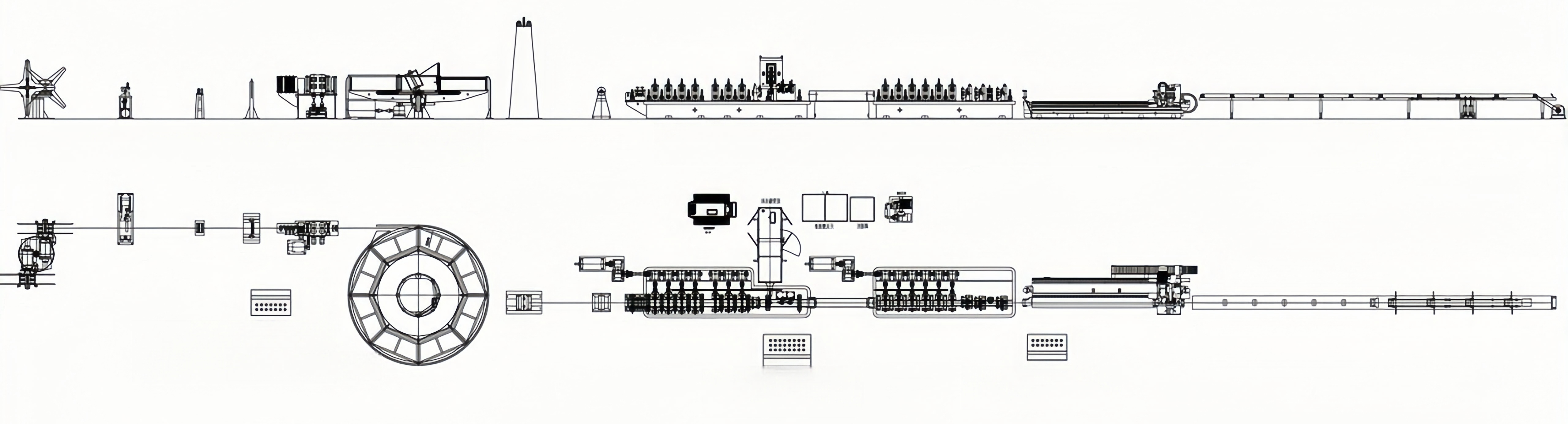
Before ordering, buyers should check whether one tube mill can realistically cover their full product mix, or whether the widest theoretical range is not the best choice for long-term production.
Why Range Alone Can Be Misleading
A machine may be introduced with a broad round tube range, but that does not automatically mean it is ideal for every square tube, rectangular tube, wall thickness, or speed target inside that range.
For example, a lighter wall round tube and a heavier wall rectangular tube may appear to fit inside one nominal range, but their forming load, welding demand, sizing difficulty, and cutting requirement can be very different.
Check Your Main Products First
The best way to judge whether one model can cover your project is to start with the main products, not with the maximum possible range. Buyers should list the real products they expect to produce most often, for example:
- Round tube: Φ25 mm x 1.2 mm
- Round tube: Φ50 mm x 2.0 mm
- Square tube: 40 x 40 mm x 1.5 mm
- Rectangular tube: 40 x 60 mm x 2.0 mm
If one machine can cover these main sizes well, then occasional sizes can be reviewed afterward.
Questions Buyers Should Ask
- Which sizes are daily production and which are occasional?
- Are square and rectangular tubes included, or round tube only?
- What wall thickness matches each main size?
- Do you need faster size changes or wider flexibility?
- Do you need cleaner cutting ends or standard cutting only?
When One Model Is Usually More Practical
One model may be practical when the buyer's product mix is concentrated around a reasonable group of sizes and thicknesses. For example, if most products stay within a stable small-to-medium range, one line may cover the project efficiently with the correct tooling and configuration.
In many projects, buyers review options such as small tube mills, medium tube making machines, or larger medium tube projects as a starting point.
When Buyers Should Be More Careful
Extra caution is needed when the project includes:
- Very different wall thickness across the size list
- Mixed round, square, and rectangular production
- Large difference between main sizes and maximum sizes
- Strict cutting quality requirement
- Expectation that one machine should cover too many products
In these cases, a supplier should carefully review the trade-off between flexibility, tooling cost, productivity, and investment level.
Tooling and Cutting Also Matter
Even if one machine model is technically suitable, buyers should still check roll tooling scope, size-change plan, and cutting system. A machine may cover the range, but tooling quantity, changeover convenience, and tube end quality can still affect whether the solution is practical in daily production.
If cleaner cutting quality is important, discuss whether a cold saw cutting system is more suitable. If you need in-house coil preparation, mention whether a slitting line is also required.
How XFX Reviews the Coverage Question
XFX Tube Mill Machinery Co., Ltd. checks actual tube size, wall thickness, tube shape, raw material, and required configuration before suggesting whether one model is suitable. We do not recommend a model only because the broad range looks close on paper.
This helps buyers avoid the risk of buying a line that appears flexible but does not match the main production plan well.
FAQ
Can one tube mill always cover round, square, and rectangular tubes?
Not always. It depends on the exact tube sizes, wall thickness, tooling plan, and configuration. Final checking should be based on the real production list.
Should I choose the widest possible model to be safe?
Not necessarily. A model that is too large may increase investment and tooling cost. The right model should fit the main production plan, not only the widest theoretical range.
What is the biggest mistake buyers make?
Many buyers compare models only by outer diameter range and forget to match each main size with the real wall thickness and shape requirement.
What should I send to check whether one model can cover my project?
Please send tube shape, exact tube size, matching wall thickness, main sizes, occasional sizes, raw material, country, purchase time, and your WhatsApp or email.
Ask XFX to Review Your Product Mix
If you want to know whether one tube mill model can cover your production plan, send XFX your exact tube list and project requirements. We will help review a practical machine and configuration direction based on your real products.
Recent Posts

October 26, 2016
The Most Successful Engineering ContractorJun 09, 2026
How to Reduce Scrap Rate in ERW Tube Mill ProductionRequest a Tube Mill Quote
Tube Mill Inquiry Information
Line Quantity
Unit
Set
Please send your tube shape, exact tube size, wall thickness, raw material, country, purchase time, WhatsApp or email, and company name. XFX will help check the suitable tube mill model and configuration for your production plan.